
Justine Tondeur
July 5, 2026 · 11 min read
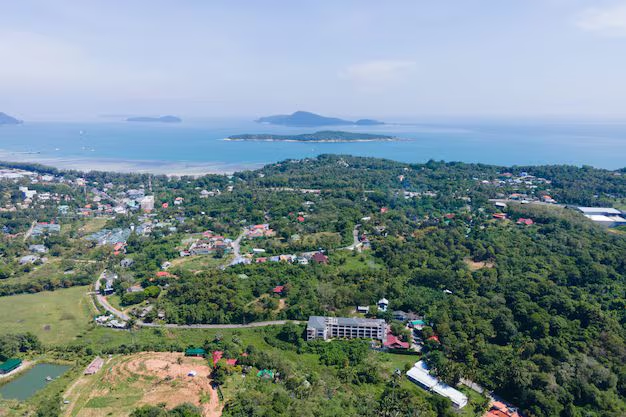
Rawai sits at the southern tip of Phuket, where the island narrows into a quiet peninsula of fishing piers, seafood markets and hillside villas. It is not the flashiest part of the island — it has no mega-mall and no beach club scene — and that is precisely why so many long-term residents and cash-flow investors choose it. Rawai is where Phuket stops being a holiday and starts being a home.
This guide covers what it is actually like to live in Rawai, who rents here, what you can realistically expect to earn, what property costs, and how to buy without the mistakes that catch first-time foreign buyers. If you already know you want to be here, you can browse our available properties in Rawai at any point.
Where Rawai Is and Why It Matters
Rawai occupies the south-eastern corner of Phuket, roughly 45 minutes from the international airport and 20 minutes from Chalong pier. It is bordered by Nai Harn to the west and Chalong to the north, and it forms a natural cluster with both — locals and agents often talk about “Rawai–Nai Harn” as a single sub-market because the lifestyle and tenant profile overlap heavily.
Two things define the area geographically. First, the seafront is a working one: Rawai Beach itself is lined with longtail boats and seafood restaurants rather than sunbathers, and the swimming beaches (Nai Harn, Ya Nui, Freedom) are a short drive away. Second, the interior is hilly, which means a large share of the villa stock enjoys real sea or mountain views — a genuine premium factor when you come to rent or resell.
The Rawai Lifestyle: Who Actually Lives Here
Rawai has the most established, year-round expat community on the island. That community shapes everything about the local market.
- Families and long-term expats anchor the area. The presence of international schools within reach, quiet residential lanes and a strong network of clinics, gyms and Western supermarkets makes it the default choice for people relocating with children or settling for the long term.
- Digital nomads and remote workers favour Rawai for its balance of affordability, community and calm. Co-working spaces, reliable fibre internet and a dense café scene support medium-term stays of one to six months.
- Retirees are a significant and stable group, drawn by the slower pace, the healthcare access and the sense of neighbourhood.
The result is a demographic that stays. Unlike Patong, where the population turns over every few nights, Rawai’s residents sign leases measured in months and years. That stability is the single most important fact for an investor to understand about this zone.
Rental Demand and Realistic Yields
Because the tenant base is long-term, Rawai is a cash-flow market rather than a peak-season lottery. Occupancy is high and consistent across the calendar rather than spiking for four months and collapsing for eight.
| Property type | Typical rental strategy | Indicative net yield* | Vacancy risk |
|---|---|---|---|
| 1–2 bed condo | Long / medium-term | 6–8% | Low |
| 2–4 bed villa (pool) | Long-term (families) | 7–10% | Low |
| Premium view villa | Mixed long / short-term | 6–9% | Low–moderate |
*Indicative net figures reflect the ranges we see across long-term lettings after management and maintenance. They are not guarantees — always model your own property with real running costs before committing.
The trade-off versus a zone like Patong is clear: you will not capture the eye-watering nightly rates of prime tourist condos, but you also will not carry the vacancy and management burden that comes with them. For an investor who wants a property that quietly pays for itself and appreciates steadily, that is usually the better deal.
A word of caution on short-term letting. Daily rental in Thailand is regulated, and not every building or villa is authorised for it. In a long-term community like Rawai this matters less than it does elsewhere, but if your business plan depends on nightly bookings, verify the legal status of the specific property before you buy. Our team checks this as part of due diligence on every listing.
What Property Costs in Rawai
Rawai sits in the affordable-to-mid tier of the Phuket market. It is materially cheaper than Bang Tao or Kamala for comparable space, which is a large part of its appeal to yield-focused buyers.
- Condos are the entry point, ideal for a first purchase or a simple buy-to-let. Freehold units are available and are the cleanest ownership route for a foreign buyer.
- Pool villas are the heart of the Rawai market. Two-to-four-bedroom villas with a private pool are what families rent and what tends to hold value best on resale. Most villas are held on Leasehold or through a properly structured arrangement — the ownership mechanics matter and we cover them below.
- View villas on the hillsides command a premium and are the most resilient segment in a downturn, because view supply is genuinely limited.
Rather than quote prices that date quickly, we keep live pricing on the site. See current Rawai listings and their asking prices for an accurate, up-to-date picture, and reach out to our team below for a private analysis of any specific property you are considering.
Schools, Healthcare and Daily Life
Practical infrastructure is where Rawai quietly outperforms flashier zones.
- Schools: Several international schools serving the south of the island are within a reasonable commute, which is the primary reason relocating families concentrate here.
- Healthcare: Chalong and Phuket Town hospitals are close, and Rawai itself has a good spread of clinics, dentists and pharmacies.
- Everyday amenities: Villa Market and other Western supermarkets, a weekly walking-street market, gyms, yoga studios and a deep bench of restaurants — from local seafood on the pier to international cafés — mean you rarely need to leave the area.
- Transport: A car or scooter is effectively essential in Rawai; public transport is thin. Factor this into any relocation plan.
Buying in Rawai: How to Do It Safely
The rules that govern a Rawai purchase are the rules that govern any Phuket purchase, but they are worth restating because getting them wrong is expensive.
- Freehold for condos. Foreigners can own condo units outright, provided the building stays within its 49% foreign-ownership quota. This is the simplest, safest title for an overseas buyer.
- Leasehold for villas and land. Foreigners cannot own land outright. Villas are typically acquired on a registered long-term lease. The lease structure, its registration at the Land Office and its renewal terms are things a good lawyer must verify — never rely on a verbal assurance.
- Avoid the nominee-company shortcut. Buying land through a Thai company with nominee shareholders was once common. It is now actively discouraged and legally risky. Prioritise Freehold or a well-structured Leasehold instead.
- Independent due diligence, always. Have an independent Thai lawyer verify the Chanote title, permits, quotas and any encumbrances before you transfer a single baht.
For the full mechanics of ownership, taxes and the step-by-step process, read our dedicated guide, Buying Property in Phuket as a Foreigner. For the specific Freehold-versus-Leasehold decision, see our Freehold vs Leasehold guide.
Rawai vs the Alternatives
To place Rawai in context against the zones investors most often compare it with:
| Zone | Best for | Character | Price level |
|---|---|---|---|
| Rawai / Nai Harn | Stable long-term yield, families | Residential, community | Affordable–mid |
| Bang Tao | Capital appreciation, luxury | Premium, resort | High |
| Patong | Maximum short-term yield | Tourist, high-energy | Mid |
| Chalong | Budget long-term living | Practical, central | Affordable |
If your priority is a low-vacancy asset that generates dependable income and suits year-round living, Rawai is the safe bet. If you are chasing headline appreciation and are comfortable with a higher entry price, Bang Tao may fit better — and we can advise on both.
Is Rawai Right for You?
Choose Rawai if you want steady rental income, a genuine community, family-grade infrastructure and an entry price that leaves room for yield. Look elsewhere if you need nightlife on your doorstep, a swimmable beach directly in front of the property, or the prestige pricing of the west coast.
For most long-term-minded buyers, Rawai delivers the best risk-adjusted proposition on the island.
Thinking about Rawai? Our team lives and works on the island and can give you an honest, property-specific assessment — including realistic yield modelling and full legal due diligence. Browse Rawai properties or get in touch with Palmora Property below for a free consultation.


